
Dmytro Kalyta
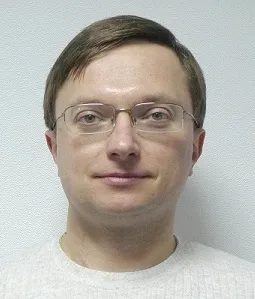
Director of the Intel Corporation office for Ukraine, Belarus and Moldova from 2014 to 2017.
In today’s world of high technology, knowledge is a constant search for something new.
Dmytro Kalyta’s story3 min read
Background
Graduated with a Master’s degree from the Department of Semiconductor Electronics of the Faculty of Radiophysics in 1998. From 1998 to 2001, he was a PhD student at the faculty (academic supervisor: Professor S. D. Pohorilyi) and taught the courses “Fundamentals of Computer Networks” and “Object-Oriented Programming” for Master’s students. Author of several scientific papers and a study guide, and co-author of two editions of the textbook “Computer Networks”, approved by the Ministry of Education and Science of Ukraine.
Hobbies: modern music, travel and gadgets.
Advice for applicants and students
My education and the time spent at Taras Shevchenko National University of Kyiv taught me not just to mechanically plug numbers into formulas and work from 8 to 5, but to think and solve non-standard problems. In today’s world of high technology, knowledge is a constant search for something new. This is exactly what is taught at the Department of Computer Engineering of the Faculty of Radiophysics, Electronics and Computer Systems.
Information technology has come an extraordinarily long way over the last 20 years. Today it is not even simple and understandable devices or systems; it is part of the life of every modern person. Knowledge has become the lifeblood of the modern global economy. The Master’s degree and the modern knowledge base I obtained at the faculty allowed me to quickly find interesting work and translate the potential of a classical education into the applied level of everyday work.
I want to emphasise that it was the university’s classical education and the efforts of my academic supervisor that, over time, allowed me to understand that it is not knowledge itself, but understanding and the ability to use the process of learning properly, that is the main competitive advantage in life. Generations of electronics and computers change every year, while the basic principles remain stable for many years.
Thanks to the university, I know how transistors work, how quantities are measured and sensors are built, how circuit design is done, what the different parts of computer systems are responsible for, where and why various algorithms are used, and the principles of building computer networks; this is the necessary foundation for my current work.
Mastering and selling the newest, most advanced technologies on the market requires an understanding of the underlying principles and a quick response. Over 6 years of study, more than half of the applied knowledge in IT can become outdated, so only constant self-education and the search for knowledge can preserve a person’s competitive advantage in the modern world.
How does “Computer Engineering” differ from “Software Engineering”?
Professional training in computer engineering means knowledge and practical skills in designing the software of computer systems and electronics (the hardware of computer systems and networks). Computer engineers design hardware and software complexes, ranging from microprocessor-based embedded systems to supercomputers, high-performance high-availability systems and cloud platforms.
Software engineering studies methods for the analysis, design, implementation and testing of software, based on the mathematical apparatus of discrete mathematics, algorithmic algebras, functional analysis, etc. Software engineers develop models and methods of software development, from theory to the practice of creating software tools.
The field of computer engineering focuses not only on individual aspects of programming, computer systems and networks, but also on their integration into existing IT infrastructures.
The field of software engineering focuses on the theory and practice of the software development process, in most cases without being tied to existing IT infrastructures and solutions.
What jobs do the department’s graduates do?
Graduates work as programmers and software test engineers, in particular in the fields of embedded devices, high-performance computing and network applications.
Artem Kramov

Research engineer in natural language processing, One AI Inc., Tel Aviv, Israel
…what matters is not only the final result, but also the path taken to achieve it.
Artem Kramov’s story2 min read
Background
His tasks involve applying artificial intelligence tools to the automated analysis of texts in various languages (English, French, Hebrew): creating summaries of articles and conversations, finding key sentences, analysing the coherence of Ukrainian-language texts and the emotional component of documents, etc.
From 2011 to 2017, he studied at the Department of Computer Engineering of the Faculty of Radiophysics, Electronics and Computer Systems of Taras Shevchenko National University of Kyiv and received Bachelor’s and Master’s diplomas with honours. From 2017 to 2021, he was a PhD student at the Department of Computer Engineering (academic supervisor: Serhii Demianovych Pohorilyi, D.Sc. in Engineering, Professor); in 2022, he received the Doctor of Philosophy degree in the field of study “Information Technologies”. His main research focused on studying and creating modern methods for processing Ukrainian-language texts using various types of artificial intelligence tools (deep neural networks, machine learning models). Author of more than 20 scientific papers, 9 of which are indexed in the Scopus scientometric database (h-index 3) and 3 in the Web of Science database (h-index 1).
Hobbies: travel, popular science literature on psychology, Eastern martial arts.
Advice for applicants and students
Despite the current tendency towards a primarily applied study of the basics of information technology, fundamental knowledge remains one of the key criteria in shaping a highly qualified specialist in computer engineering. Understanding the basics of circuit design, modern programming methods, the theory of algorithms or elements of mathematical analysis, which are taught as part of the university’s classical education, is a critically important step towards further mastering and creating the newest methods both in computer engineering and in a number of related fields.
The combination of fundamental knowledge, an understanding of modern technologies, the ability to learn and the desire for constant self-education makes it possible to distinguish high-level specialists from other candidates on today’s IT labour market. Besides acquiring these skills, studying at the Department of Computer Engineering made me understand the following: what matters is not only the final result, but also the path taken to achieve it. Therefore, the well-known Latin saying “Per aspera ad astra” (“Through hardships to the stars”) will always accompany and inspire graduates of the Department of Computer Engineering in achieving their next goal.
Maksym Slynko

Software Project Manager at Lyft
“Learning how to learn” is, in my opinion, one of the most important achievements of the department’s graduates.
Maksym Slynko’s story2 min read
Background
Graduated with a Master’s degree from the Faculty of Radiophysics, Electronics and Computer Systems in 2016. Defended his Doctor of Philosophy dissertation at the Department of Computer Engineering in 2020 (academic supervisor: S. D. Pohorilyi, D.Sc. in Engineering, Professor) and took part in teaching the courses “Discrete Mathematics” and “Data Exchange System Interfaces” for Bachelor’s and Master’s students. I have extensive experience in software development in various fields, in particular robotics and digital forensics.
Advice for applicants and students
A classical education is essential for engineers, as it provides valuable critical thinking and analytical skills that are necessary for solving complex technical problems. Engineers must be able to analyse different possible solutions and choose the most effective one. In addition, they must have the mathematical skills provided by a classical education in order to be able to calculate complex systems and loads on structures.
I gained many applied skills while studying at the Department of Computer Engineering: programming languages of different levels, algorithms, the foundations of artificial intelligence, the principles of computer networks, etc. However, the field of information technology is developing at a rapid pace. You should not think that learning ends the moment you receive your diploma. “Learning how to learn” is, in my opinion, one of the most important achievements of the department’s graduates. This is ensured both at the basic level, when completing the educational programmes, and at the advanced level, when working on the department’s research programmes.
Yes, graduates may have to work with programming languages other than those they used during their studies, or with different hardware, but the approaches and the ability to find critical points and focus on what matters most will stay with you forever. For example, throughout my career I have repeatedly used the knowledge of discrete mathematics gained during my studies, not only to simplify program code, but also to uncover hidden business logic rules. Each time, this gave me a competitive advantage.
My PhD studies and dissertation defence at the Department of Computer Engineering laid a solid foundation for my career development. Our teachers are true professionals in their field, able to prepare students for the challenges that await them in the modern world.